

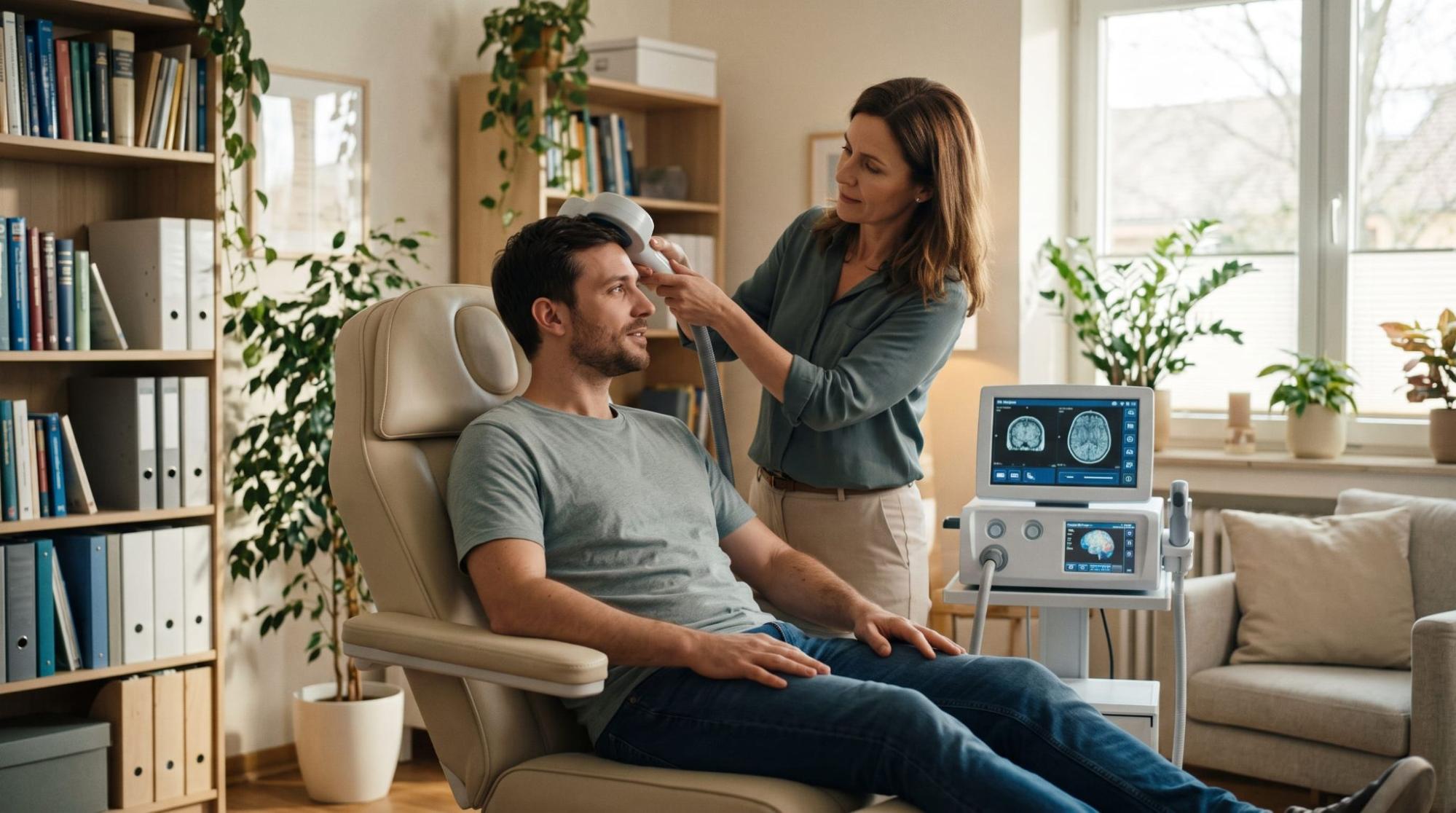
Yes, transcranial magnetic stimulation (TMS) can help treat obsessive-compulsive disorder (OCD), especially for people who do not improve with standard medications or therapy. The FDA has cleared specific TMS systems as an add-on treatment for adults with treatment-resistant OCD, and clinical research shows that roughly 45 to 55% of patients experience a meaningful reduction in symptoms. TMS does not replace the first-line treatments; it joins them, and that distinction shapes everything about how the treatment is used. Below, we walk through how TMS works for OCD, what the evidence shows, what treatment looks like, and how to find out whether it fits your situation.
TMS can help with OCD, and its role is specific: it serves people who have already tried the standard treatments without enough relief. According to the International OCD Foundation, about 70% of people with OCD experience at least some benefit from exposure and response prevention, medication, or a combination of the two. That leaves a meaningful group still struggling after doing everything right, and over the past decade TMS has progressed from an experimental option into a research-backed treatment for exactly that group.
The foundation’s guidance stresses one principle worth understanding before anything else: TMS for OCD is designed as an add-on, provided alongside medication or ERP rather than in place of them. That is different from how many people imagine new treatments working, and it is actually good news. You do not have to abandon the progress you have made with OCD treatment to add TMS; the approaches stack.
TMS works for OCD by using targeted magnetic pulses to change activity in the specific brain regions involved in the disorder, primarily the medial prefrontal cortex and anterior cingulate cortex. OCD involves overactive brain loops that keep sending false error signals, the “something is wrong, check again” alarm that drives obsessions and compulsions. TMS calms that overactivity. Session by session, the stimulation nudges those circuits toward more typical patterns of activity, which is why the effects build over a course of treatment rather than appearing after a single visit.
OCD treatment protocols include one step that surprises people: a brief, guided provocation before stimulation begins. Your provider asks you to briefly bring an OCD trigger to mind just before the session, which activates the exact brain circuit the magnetic pulses are meant to reach. The moment is short and planned with you in advance, and it exists for a practical reason, since an engaged circuit responds to stimulation better than a quiet one. During the stimulation itself, you sit in a chair, awake, wearing earplugs, feeling a tapping sensation on your scalp, the same basic experience as TMS therapy for depression.
Yes, the FDA has cleared specific TMS systems as an adjunctive, or add-on, treatment for adults with obsessive-compulsive disorder. The clearance is precise rather than blanket: it covers particular devices, using high-frequency stimulation protocols, aimed at the brain targets involved in OCD, and paired with the pre-session symptom provocation described above. The International OCD Foundation describes effective OCD treatment as a “recipe” of device, protocol, and brain target, and the FDA clearance applies to the combinations research has validated.
What this means practically is that TMS for OCD is a more specialized undertaking than TMS for depression, and the right starting point is a conversation rather than an assumption. A psychiatric evaluation establishes your diagnosis, your treatment history, and whether the add-on criteria fit your situation, and from there your provider can map which treatment path, and which type of TMS, makes sense for you.
TMS produces a meaningful reduction in OCD symptoms for roughly 45 to 55% of patients who complete treatment. The lower figure comes from a prospective multicenter randomized controlled trial published in the American Journal of Psychiatry, which found that about 45% of patients had reduced OCD symptoms at one month following treatment. The higher figure comes from real-world data published in the Journal of Psychiatric Research, collected across 22 clinical sites, where the response rate exceeded 55%. For a group of patients whose OCD had already resisted standard treatment, those numbers represent genuine progress.
Two honest notes belong beside the statistics. First, “meaningful reduction” is the accurate promise; TMS lessens symptoms substantially for many people, and it is not framed as a cure. Second, some patients benefit from occasional maintenance sessions after the initial course, which the International OCD Foundation notes may mean returning every week or two for a period of time. Your response gets tracked with symptom rating scales throughout treatment, so decisions about maintenance rest on your actual numbers rather than guesswork.
TMS treatment for OCD runs five days a week for about four to six weeks, in outpatient sessions where you stay awake, hear clicking sounds, and feel tapping on your scalp. There is no anesthesia and no downtime; you drive yourself to the appointment and return to your day immediately afterward. Each session includes the brief provocation step followed by the stimulation itself, and the appointment fits inside a normal daily schedule the way a gym session would.
Side effects stay local rather than systemic, which is one of the treatment’s most appealing traits. Mild scalp discomfort or temporary headaches are the most common effects, and they typically ease within the first week or two of treatment. Tingling or brief twitching of facial muscles during pulses can occur, and the systemic side effects associated with medication, like weight gain or fatigue, do not happen with TMS. Serious effects such as seizures are rare, which is why screening for metal implants in or near the head and a review of your health history happen before treatment begins. Every one of those screening questions belongs to the same careful process our psychiatric services team applies to any treatment decision.
TMS fits with ERP and medication as the third layer of a treatment plan, not as their replacement. Exposure and response prevention remains the gold-standard therapy for OCD: it teaches you to face triggers without performing compulsions, and it produces durable change because the skills belong to you permanently. Medication, often prescribed through medication management, reduces the biological intensity underneath the symptoms. TMS enters when those two, alone or together, have not brought enough relief.
The combination logic runs deeper than simply adding options. Clinical experience cited across the OCD treatment field suggests TMS often makes exposure therapy work better by turning down the overwhelming intensity of symptoms, so the exposures feel survivable enough to actually practice. Someone whose distress ran at a level that made ERP feel impossible may find, partway through a TMS course, that the same exercises have become workable. That is the quiet way these treatments reinforce each other: one lowers the wall, the other teaches you to climb it.
You find out whether TMS fits your OCD through a psychiatric evaluation that reviews your diagnosis, your past treatments, and your overall health. Candidacy generally comes down to a short list of factors your provider walks through with you:
Our team brings direct experience with this technology, since we provide TMS in-house rather than referring patients elsewhere. The treatment suite operates at our Greensburg office, and the psychiatric providers who evaluate your OCD are the same team that oversees the technology.
That combination matters more than any single treatment, because effective OCD therapy is rarely one thing. It is the right therapy, the right medication decisions, and the right add-ons, sequenced by a team that tracks how you respond and adjusts as you go.
TMS for OCD produces a meaningful reduction in symptoms for roughly 45 to 55% of patients, based on a multicenter randomized trial in the American Journal of Psychiatry and real-world data from 22 clinical sites. Success rates apply to people whose OCD had already resisted standard treatment, which makes those figures especially encouraging.
No, TMS does not replace ERP or medication for OCD. It is cleared as an add-on treatment provided alongside them, and the International OCD Foundation recommends trying ERP and medication first. Many patients find TMS makes ERP easier to engage with by lowering the intensity of their symptoms. It is possible that with successful TMS treatment, that in the future you would be able to reduce reliance on medication and psychotherapy and enter full remission.
TMS treatment for OCD typically takes four to six weeks of sessions held five days a week. Each visit is brief, requires no anesthesia or recovery time, and fits within a normal daily routine. Some patients later return for occasional maintenance sessions if symptoms begin creeping back.
The side effects of TMS for OCD are mostly mild and local: scalp discomfort, temporary headaches, and occasional brief twitching of facial muscles during pulses. These typically ease within the first week or two. Systemic effects like weight gain or fatigue do not occur, and serious effects such as seizures are rare.
TMS is not expected to make OCD worse, though the brief provocation step before each session intentionally stirs symptoms for a moment so the right brain circuit is active during stimulation. That discomfort is short and planned. If you notice your symptoms changing in a way that concerns you at any point during treatment, tell your provider, who can adjust the plan.
TMS can help with OCD, and it helps in a specific, well-defined way: as an FDA-cleared add-on for adults whose symptoms have outlasted medication and therapy, with roughly half of patients experiencing meaningful relief in clinical research. It works alongside ERP and medication, often making both more effective, and the path to it starts with an honest evaluation of what you have already tried.
If OCD has kept its grip despite real effort in treatment, the team at the Counseling and Wellness Center of Pittsburgh can evaluate where you stand and build the next layer of your plan, with therapy, medication, and TMS available across our Western Pennsylvania offices. Schedule an appointment today, because treatment-resistant does not mean treatment is finished.
Reviewed by Stephanie Wijkstrom

Understanding Revenge Bedtime Procrastination: Why We Steal Rest from...
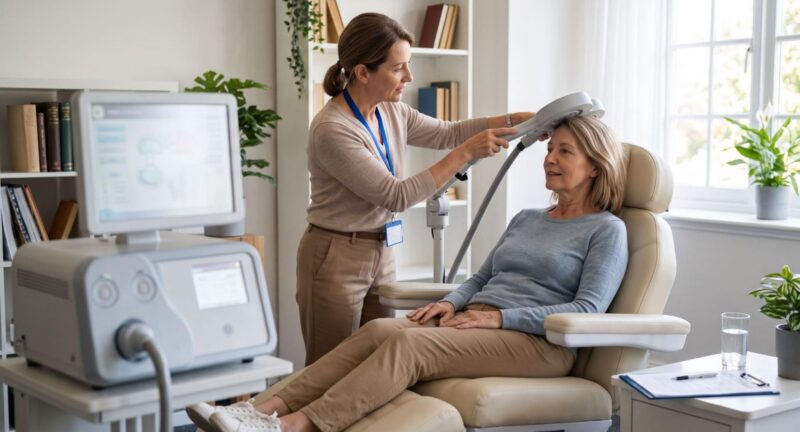
A TMS session is a non-invasive, outpatient procedure in which you recline...